
ARCHAEOLOGY JOURNALS
ARCHAEOLOGY (sometimes spelled "ARCHEOLOGY") is the study of human activity through the recovery and analysis of material culture (aka human "things"). The archaeological record consists of artifacts, architecture, biofacts, sites, and cultural landscapes. Archaeology involves surveying, excavation, and analysis of data collected, to learn more about the human past.
The year is 1939, and you are a young archaeologist who works for Charter University. Your job is to travel the world and help protect human sites and artifacts before they are destroyed, or fall into the wrong hands! Before traveling, you'll need to conduct careful research, and collaborate with other archaeologists in order to prepare for your archaeological adventure.
Once your feet are on the ground, you will start an archaeology journal, with first-person narration and several illustrations and diagrams. Think of this as part personal journal and part archaeological scrap book. Just remember the year is 1939, not 2026!
Page 1: MEMENTO MORI March 15, 1939 (The Ides of March)
Your plane lands in Rome, and before you make it to your hotel, someone passes you a folded piece of parchment paper, with a note and diagram in Latin. You translate it, and it seems to be something about a hidden treasure underneath the city. Apparently, there are 23 ancient daggers, and several "Augustus Caesar" coins. ... Tell this story, then continue it in the form of a FIRST PERSON journal entry. Try to use facts about Roman art and/or architecture and engineering, as you tell the story. Consider XXIII (23 in Roman numerals) or VIGINTI TRES (23 in Latin). Maybe you enter an hidden cave under Rome, that has a vaulted ceiling, or murals on the wall. Maybe you find another clue and it has a Latin proverb.
Page 2: Create an illustration that either mirrors your story, or shows a diagram with illustrations and labels, or perhaps a copy of the parchment note in Latin. Synthesize your new knowledge, use your creativity and make it original!
Page 3: SECRETS OF THE CATHEDRAL March 28, 1939
After your adventure in Rome, you are called to Paris, France, specifically to Notre Dame Cathedral. Underneath the famous Cathedral, newly discovered evidence is believed to prove that before construction began in 1163, there was an old Roman city called Lutetia. At the exact site of the Cathedral, there stood a Roman temple dedicated to the god Jupiter. Your job is to uncover artifacts that prove this, and bring them to the Louvre Museum in Paris. Tell this story in the form of a journal entry, and use at least three vocabulary words from Chapter 3.
Page 4: Create an illustration of a diagram that adds to your story. Synthesize your new knowledge, use your creativity and make it original!
OPTIONAL (+2 extra credit): While working on the excavation at Notre Dame, you uncover a plot to steal The Crown of Thorns. Tell the story of how you saved the relic. Here's what you need to know: According to the New Testament gospels, Roman soldiers placed a woven crown of thorny branches on Jesus' head to mock his claim as the "King of the Jews" before his crucifixion. The sacred relic was believed to be held in Constantinople until 1239. In that year, Emperor Baldwin II of the Byzantine Empire sold it to King Louis IX of France. It has been at the Notre Dame Cathedral ever since.
Page 5: ... You'll have to wait for your next adventure.
illustrated narrative journals from 1939
BEFORE COLUMBUS
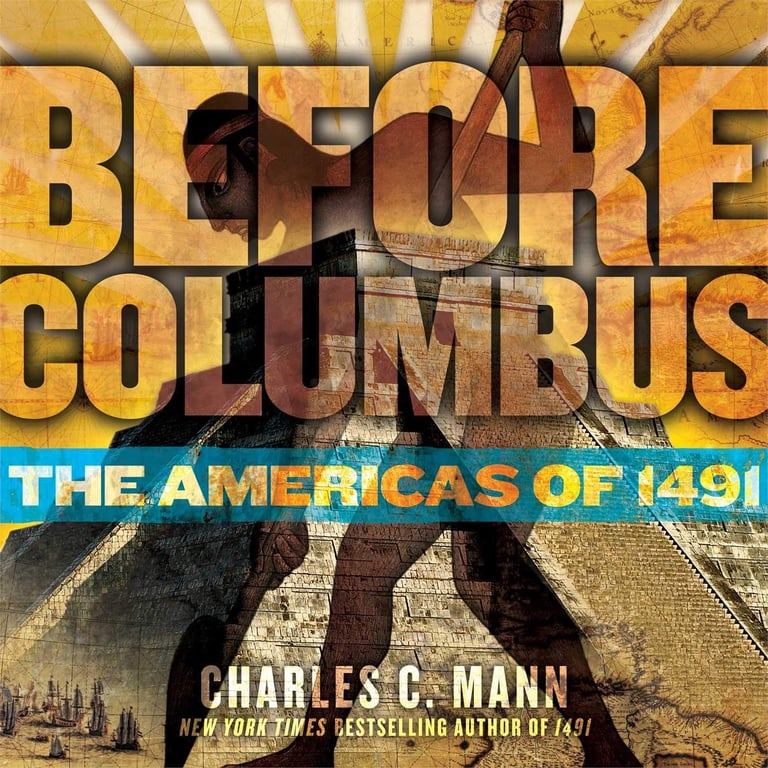

In this beautifully illustrated and concise adaptation of 1491: New Revelations of the Americas Before Columbus, Charles Mann paints a superb picture of pre-Columbian America for middle school students. In the process, he overturns the misconceived image of Natives as simple, widely scattered savages with minimal impact on their surroundings. Well-chosen, vividly colored graphics and photographs of mummies, pyramids, artifacts, and landscapes as well as the author's skillful storytelling will command the attention of even the most reluctant readers. Eye-catching sidebars and oversize chapter headings seem to pop from the pages. Mann constructs the narrative around three crucial questions that continue to confound historians today: Was the New World really new? Why were the Europeans successful? What ecological impact did Natives have on their surroundings? From the pre-Columbian genetic engineering of maize to the existence of pyramids older than the Egyptian variety, Mann's lucid answers to these questions represent current scholarly opinion and point the way toward future exploration and discovery.
UNDERWATER ARCHAEOLOGY


Students will work in teams to explore a shipwreck in 1509. What do the artifacts tell us? What is the "Colombian Exchange?"